Breeding a mare can involve a surprising amount of record keeping — this is especially true if you get a "problem mare."
If you have a repro vet managing your mare, you might assume that you don't need to keep your own records. You do. If you change vets it can be difficult to get the kind of detail you might want in a handover. And your mare is your horse. You will be the one advocating for her, watching her day to day throughout her pregnancy, and responsible for her care. The buck stops with you.
Then there's the emergency scenario. Say your mare colics. The emergency on-call vet is probably not your repro vet, and in an emergency they may want the details of your mare's pregnancy status. You need those answers to hand, because horse emergencies rarely happen within clinic office hours.
Good mare management records don't need to be complicated. The important thing is that they are accurate, consistent and easy to find when you need them.
Why keep detailed mare breeding records?
It is easy to remember what happened with a mare the week it happened. But six months later — that's harder. Several breeding seasons later … whoops!
A detailed record gives you a history you can refer back to rather than relying on memory. For example, you may want to know:
- Did she have a culture and cytology done before breeding? What were the results?
- Which stallion was she bred to?
- When did she ovulate? Which ovary did she ovulate out of? Was an ovulation-inducing drug used, and how did she respond to it?
- Does she have any cysts mapped?
- Was she bred using live cover, fresh semen, cooled semen or frozen semen?
- When was pregnancy confirmed? How many cycles did it take to get her in foal?
- When did she previously foal, and at how many days gestation?
- Has she had difficulty becoming pregnant in the past? What about hemorrhagic follicles?
- Has she had any reproductive treatments? Flushes? Infusions?
- Who was involved in managing her breeding?
Honestly, that might look like a lot, but that list is not the half of it. We are just getting started here.
What breeding records should you keep for a mare?
Answer: as much as you can.
Heat cycles and seasons
Recording the mare's reproductive cycles helps build a picture of how she normally behaves. This is especially helpful when she stops behaving normally, as mares are apt to do from time to time.
You might record:
- The date she entered heat
- Duration of heat
- Signs of estrus
- Teasing results
- Reproductive examinations
- Changes observed during the cycle
Over time, these records can help you and your veterinarian understand the mare's individual pattern. The funny thing is that when you know you're going to log something, you pay more attention. We bet that if you start logging behavioral signs of estrus, you'll realize you notice them better, and can predict the early signs that your mare is coming in.
Reproductive examinations
Reproductive examinations can generate a considerable amount of information. You do not want any of it to get lost. And you want to be able to access it when you want it, not just when your vet's office is open.
Depending on the mare and the circumstances, records may include:
- Ultrasound examinations
- Follicle development
- Uterine findings and uterine edema
- Cervical findings
- Ovarian findings
- Cytology and culture results
- Other diagnostic tests
Ovulation
The date of ovulation is one of the particularly useful pieces of information to record, because ideally her gestation timeline should be generated from that date rather than the date she was bred. They are not necessarily the same.
If you can record when she ovulated, you can also build a picture of how long she was in season, which may help you estimate the breeding timing that works for her in years to come. You can also record whether she had any fluid after ovulation, have it treated accordingly, and record the results. That way, if she has fluid next time, you already know what protocol worked.
Breeding
At a minimum, breeding event records might include:
- Date of breeding
- Stallion
- Breeding method
- Whether the breeding was successful — you have to wait for the pregnancy check for this one
- Relevant notes
The breeding method may be particularly important, because breeding a mare by live cover is a different process from breeding her using fresh, cooled or frozen semen. You may think you'll always remember whether your mare took or missed with frozen, but seven years down the line you'd be surprised how bad your recollection is. Digital records don't forget things the way human brains do.
For shipped semen, you may also want to retain information about the shipment and the semen used. What was the semen quality? Which extender was used? Did you manage to breed her before ovulation, after, or both?
A complete breeding history lets you see the sequence of events rather than simply recording that a mare eventually became pregnant.
Pregnancy checks
Oh, the anticipation of waiting 14 days.
Record:
- Date of the pregnancy examination
- Pregnancy status — single or twin? Was it the right size?
- Relevant findings — was a CL present? Fluid?
- Any follow-up examination required
Of course we all jump for joy if a mare is found pregnant on the 14-day scan, but don't let your happiness stop you logging the important stuff. What was the CL quality? Was the pregnancy a good size, or on the small side? Was there any fluid or edema in her uterus? Logging things like these means that if she absorbs the pregnancy, or the embryo dies off before the heartbeat check, you may be able to understand why.
Pregnancy and expected foaling date
Once pregnancy has been confirmed, the mare's record should let you track the pregnancy. This can include:
- Pregnancy confirmation date
- The breeding or ovulation date used for the pregnancy calculation
- Expected foaling date
- Pregnancy-related treatments or examinations
- Important vaccination or management dates
- Actual foaling date
Now, we all know that mares do not care for due dates, but mare owners certainly do.
Foaling records
This one is huge, and it's definitely something that most of us, in the heat of the moment, forget to do well. But we all remember how small we feel the first time our vet asks "how long was she in stage two labor for?" and we don't know, because we forgot to log the times in the excitement of it all.
If everything goes well, you likely won't need those notes other than for your own knowledge. But if anything goes wrong with the foal in the first couple of days, the vet will always want the precise details of the birth.
The foaling itself should also become part of her reproductive history. She might have a really long stage two labor one year and you'll want to check back and see what her average was. Or she might be looking itchy and you can't remember whether that was one of her stage one signs last year.
Reproductive treatments
If a mare requires treatment or additional reproductive management, it is useful to keep that information with her breeding history. No — that's not right. It is a lot more than just useful. It can save you a lot of time and money.
If your mare needs flushing after ovulating, knowing that can save you a missed cycle. If she doesn't respond to hCG but responds to deslorelin, knowing that can save you a wasted collection and shipping fee.
This might include records relating to:
- Uterine treatments
- Cultures and cytology
- Pre-breeding management
- Post-breeding management
- Previous reproductive problems
- Other veterinary interventions
And you might think it's fine to let your vet keep these records — it is, but you should have them too. You might move locations, change vets, or sell the mare to a new owner who wants her records.
Managing mare breeding records with StallionApp
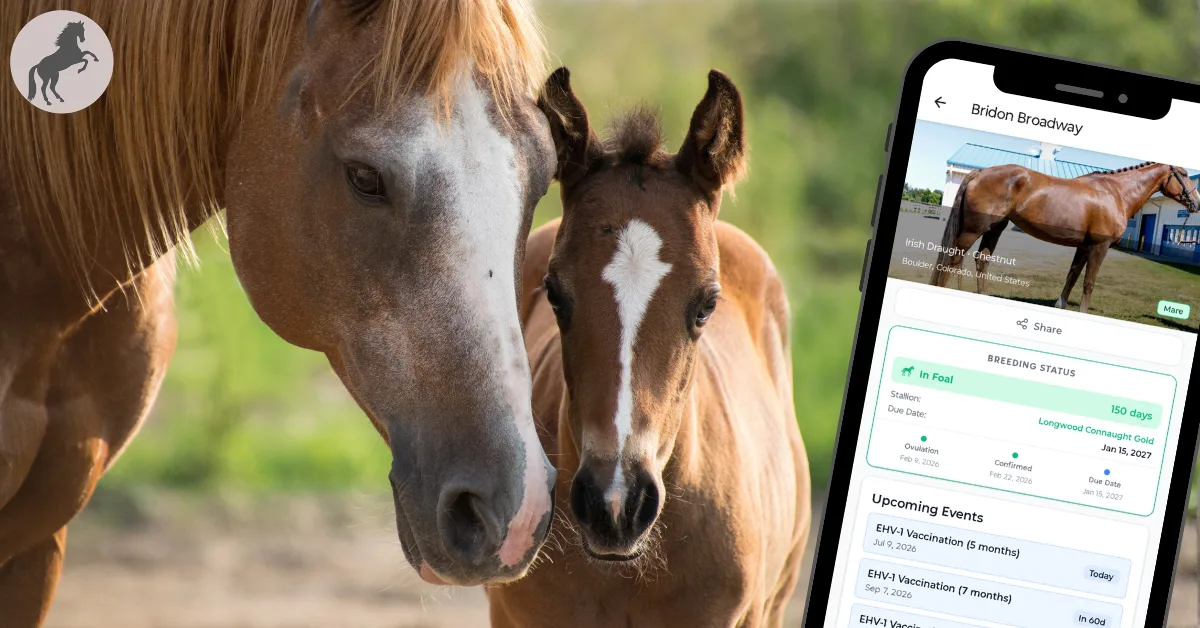
Hopefully, if you've read this far, we've convinced you that you should be keeping your own breeding records for your mare. Good — it just so happens that we built an app for that. You're welcome.
StallionApp is designed to keep the information associated with a mare's breeding program together. You can maintain an individual mare record and add reproductive events such as heat cycles, examinations, ovulation, breeding events and pregnancy checks. Breeding events can be associated with the stallion used, and pregnancy information can be used to generate a pregnancy timeline and expected foaling information.
Basically, we do everything we've outlined in this article and a heck of a lot more. The aim is to make the mare's breeding history something you can see and use, rather than a collection of individual records scattered across different places.
Where to go next
- New to this? What Is Horse Breeding Management Software?
- Season coming up? Preparing for Breeding Season
- Difficult mare? Older Maiden Mares: The Tight Cervix Problem