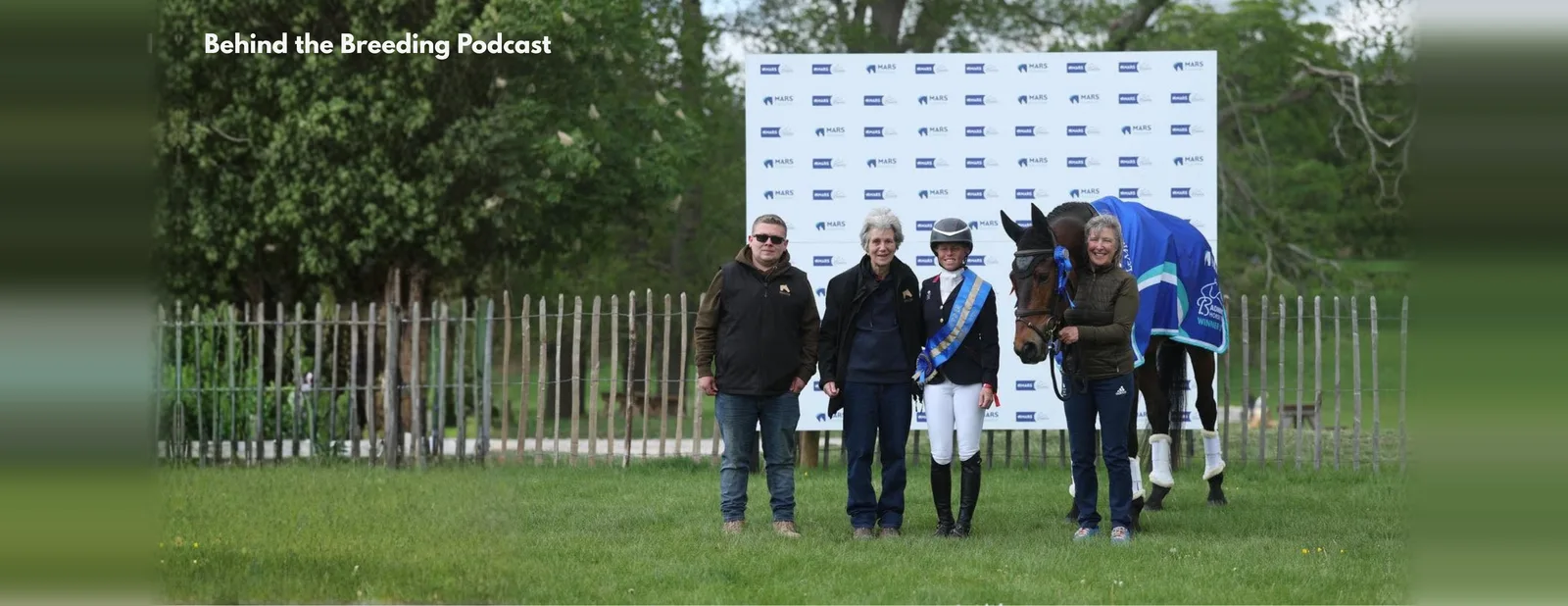
Twenty years ago, Pennie Wallace was teaching at Writtle University College in Essex, England. She had already developed a passion for breeding and was running her own small breeding program alongside her academic career. A chance connection between the college and stallion owner Ken Rehill set in motion a chain of events that would eventually produce an Olympic gold medallist.
Pennie had been inviting people from the horse industry to speak to her students. One of those speakers was Ken, who owned the Stallion Company and stood stallions including Grafenstolz. On one visit to the college, Ken asked Pennie if she could show him around the stud.
"I think I could do something to help the college in terms of educating students," Ken suggested, including giving them the opportunity to use his stallions and produce youngstock for the British Breeding Futurity.
The idea was that the college would receive sponsored breedings, and the students would be involved in producing and presenting the resulting young horses. At the time, Pennie owned a mare called Cornish Queen.
"I said, well, would you be interested if I put my mare forward to the breeding program just to add some different bloodlines?"
Cornish Queen was loaned to the college for two breedings. The first was to Grafenstolz and the resulting foal was Lordships Graffalo. The second breeding produced Lordships Park Royale, a filly by Parco.
"I think we all hoped for great things," Pennie says. "But none of us at this stage — this was 2011 — hoped for… breeding an Olympic horse. You know, that's the icing on the cake really."
Cornish Queen
The story of Lordships Graffalo starts with his dam, Cornish Queen. Pennie bought Cornish Queen from Bridget Parker, the former Olympic gold medallist who had bred her from her own mare, Cornish Fair. Cornish Fair had competed at Badminton and Burghley with Parker's daughter, Katie Burton, and subsequently became a successful broodmare.
When Pennie bought Cornish Queen around 2006, she was in foal to a Thoroughbred. That foal, Penco's Top Gun, was the first horse Pennie bred from her. She then bred Cornish Queen to Jumbo, producing Penco's Crown Jewel.
Crown Jewel — known as Jasmine — was an athletic foal and went to the British Breeding Futurity, where she gained Elite status in 2009.
Bridget Parker was initially interested in buying Jasmine, but circumstances meant she was unable to do so at the time. Pennie eventually sold the weanling to Annie Makin and her friend Kate James. That sale would turn out to be another important piece of the puzzle.
When Annie bought Jasmine, she asked Pennie what she would do with the mare if she were keeping her. "I said, well, if I had the money, I would try and do embryo transfer with her and I would try and put her with a top competition rider." Annie bred two embryo transfers from Jasmine before the mare even started competing, and then began looking for the right rider. She chose a young Ros Canter, who had recently set up on her own after working for Judy Bradwell.
At the time, Ros was not yet the household name she is today and Jasmine was one of the first horses to go to her. "I will forever be grateful to Annie for choosing Ros," Pennie says.
That relationship eventually led to Walter.
Lordships Graffalo arrives
Lordships Graffalo was three when he went to Ros Canter in September of his three-year-old year.
"He was quite gangly," Pennie recalls. "He was all legs."
Until that point, he had spent most of his time in a field with other young horses. He had been to the Futurity as a foal and again as a two-year-old, but had done very little else.
Then Pennie saw him under saddle for the first time. Ros had broken him in that autumn, and Pennie remembers watching him trotting and cantering through mud and puddles alongside Ros's established five-star horse, Allstar B. It was the beginning of an extraordinary career.
Pennie could not afford to campaign Walter herself, so she told Ros that if she knew of someone who wanted to buy him, she was open to the idea. His first proper competition as a four-year-old was a Burghley Young Event Horse qualifier in Norfolk. "He jumped the moon over the fences."
Walter finished third in the qualifier and qualified for the Burghley Young Event Horse final, and that is when Michele Saul came to see him there and ultimately bought him. She has owned him ever since.
That continuity has been particularly special for Pennie. Walter stayed with Ros, rather than passing from rider to rider, and Ros has ridden him throughout his career apart from the period when she was pregnant.
And then came the results that nobody involved in that original university breeding project could have imagined: Badminton, Burghley, Burghley again, Olympic gold.
For Pennie, it remains almost impossible to believe.
"Things like this don't happen to people like me," she says. "It's just completely unbelievable."
The next Cornish Queen foal
Cornish Queen remained with the Lordship breeding program for her second sponsored breeding. This time she was bred to Parco, the Olympic show jumping stallion. The result was another filly: Lordships Park Royale, known as Polly.
Polly also went to Ros as a three-year-old. Pennie was keen to retain an interest in the mare and asked Ros if she knew anyone who might be interested in becoming a part owner. Ros found Margie Wardrood. Polly was competed by Ros, with Alex Postolsky taking over the ride during Ros's maternity leave.
It meant that three horses bred from Cornish Queen — Walter, Jasmine and Polly — ultimately went through Ros's yard. For Pennie, the connection between them is one of those things that could easily have gone another way.
"If I hadn't have sold the first one to Annie Makin, the others might not have gone to Ros Canter," she says.
"The path might have been different."
And then there is Bling
Cornish Queen's next notable offspring is Penco's Arctic King, by Chilli Morning, known as Bling. He is a bright chestnut with four white socks, a lot of white on his face and a white splash underneath his belly.
Unlike Walter and Polly, Bling has not gone to Ros, partly because Ros does not work with stallions. Instead, he grew up at Heritage Coast Stud in Suffolk, where he was able to live out with other young male horses.
For Pennie, that upbringing is an important part of his story. He was able to grow up in a herd environment, develop his leadership skills and, importantly, learn how to interact with other horses. "He's got a really nice temperament," Pennie says. "Particularly charming."
Bling was broken in as a three-year-old and has spent much of his recent life standing at stud. He initially stood at West Kington Stud and is now standing at Bracken Spa Stud in Lincolnshire, where he is also being kept in work.
His breeding career is still in its early stages. His first season at stud was in 2023, when he covered five mares and got all five in foal. Two of those mares belonged to Pennie, allowing her to see what he would produce.
His first crop are now two-year-olds. Some have already been to the Futurity and done well, including one that received a Gold Premium. But Pennie knows that breeders can be cautious about young stallions.
"Some people want to see the progeny doing things."
For now, the demand for Bling is predominantly for fresh and chilled semen. As his competition career develops, Pennie may move more toward frozen semen and concentrate more on his ridden career.
The dam line
It is difficult to look at Cornish Queen's offspring without looking further back. Her dam, Cornish Fair, was bred and competed by Bridget Parker and subsequently became a prolific broodmare.
Further back is Tregea, who produced five advanced event horses. And behind her is April the First, who was also a Grade A show jumper and produced four-star horses.
The family is also connected to Cornish Gold, Parker's 1972 Olympic gold medal horse. Then there are the other familiar names in the pedigree, including Ben Faerie and the bloodlines behind Ginny Elliott's Priceless and Nightcap. It is, as Pennie puts it, a who's who of British eventing.
And it raises an interesting question about breeding: how much of a successful breeding program is about finding the right mare family and then making the right decisions around it?
For Pennie, breeding the horse is only part of the equation.
Breeding is only the beginning
Pennie is remarkably candid about the realities of breeding horses. For all the success that has come from Cornish Queen, she has experienced the other side of breeding too.
"I have lost mares, foals, etc. in the past," she says. "Things go wrong as well as things going right."
She believes breeders need to have clear goals and think carefully about what happens to their youngstock after they are born.
"You can breed the best horse in the world, but if it goes to somebody who can't fulfill its potential, then it can be incredibly frustrating."
For Pennie, the fact that several of her horses went to Ros Canter was partly good decision-making and partly luck. She also believes breeders need to be realistic about how difficult the current breeding market is. Costs are rising. Producing horses properly is expensive. And breeders are increasingly having to think carefully about how many horses they can afford to produce.
"I think in today's climate, you've got to try and breed the best you can, but not breed too many."
Her advice to young breeders is:
- Set your goals.
- Research.
- Breed selectively.
- Give the resulting horses the best start you can.
- And think about who is going to produce them.
"Breeding them is only part of the equation," she says. "It's the producing and riding that is so, so important."
That may be one of the most important lessons in Walter's story.
There was a mare with a good pedigree. A sponsored university breeding. A stallion chosen for a particular purpose. A foal that looked rather gangly as a three-year-old. A young rider who was not yet famous. An owner who decided to buy him.
And a whole series of decisions, relationships and fortunate circumstances that eventually led to Olympic gold.